Human
How many eyes does my foot have?GPT-3
Your foot has two eyes.Whether you believe this is the dawn of a new renaissance or the beginning of something more troubling, we are living through one of the biggest evolutionary leaps of our time.
Six years. A different world.
The change is easiest to understand not in benchmarks, but in what suddenly became possible.
Human
How many eyes does my foot have?GPT-3
Your foot has two eyes. Basic biology and physics broke.
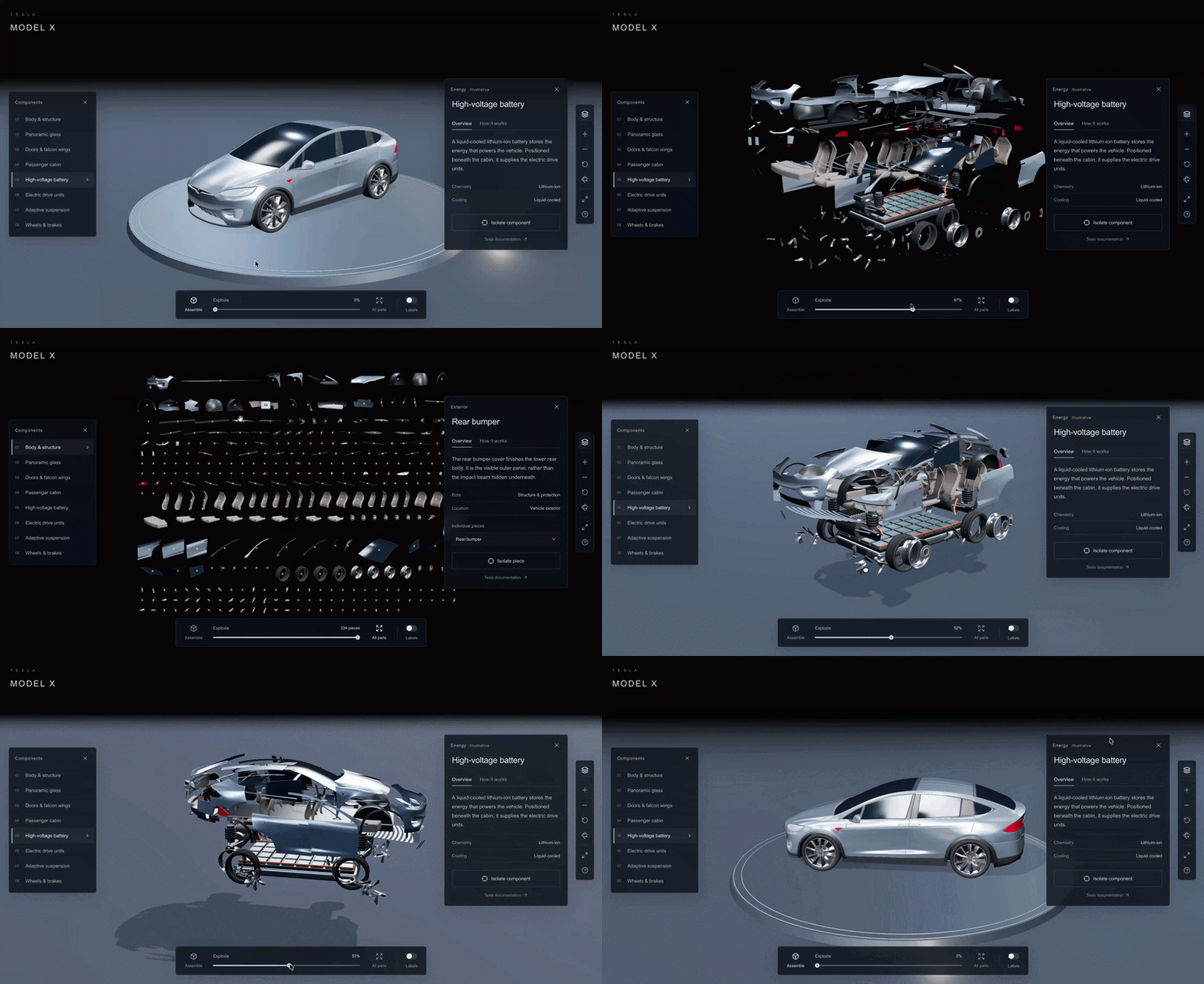 Immersive product experiences, generated in minutes.Customers can break down and understand every detail.
But the most consequential shift is not only what AI can do.
It is how our role changes as we hand it more of the journey between a prompt and an outcome.
Era 01 · Execution
We gave AI a specific task. It executed — while we held the thinking and the decisions.
Draft this copy
Summarise this document
Analyse this data
Era 02 · Judgement
We brought AI a problem. It helped explore and recommend — while we still decided where to go.
Explore the options
Evaluate the trade-offs
Recommend a direction
Era 03 · Goals
Now we give AI an outcome. The choices between intention and result are increasingly its to make.
Choose the tools
Sequence the work
Make decisions in-between
As AI increasingly makes decisions on our behalf…
The intelligence it uses to make those decisions becomes critical.
Model intelligence is reasoning, general knowledge and pattern recognition. Organizational intelligence is your data, audiences, context, experience, KPIs and institutional memory.
What the model brings
Reasoning · General knowledge · Pattern recognition
What your organization brings
Data · Context · Experience · KPIs · Institutional knowledge
The model moves quickly — without enough of your organization to know where it should go.
Move the control. Change the intelligence behind the decision.
Better AI cannot compensate for bad intelligence.
Poor decisions,
faster.
No matter how advanced the model becomes, it cannot compensate for the intelligence it was never given.
So the question you need to ask yourself as a leader is…
Are my teams using AI?
Have I fostered a culture of data and intelligence to maximize its impact?
Not a slogan. A system shaped by what leaders measure, what they connect and what they give room to grow.
Responsibility
Teams naturally optimize for what leaders measure. If the message is simply ‘use AI to save time’, efficiency becomes the ceiling. Measure whether AI improved the decision, deepened stakeholder understanding or raised the value of the work.
Don’t ask what AI helped teams do faster. Ask what it helped them do better.
Integration
Integration is not putting disciplines in the same meeting. It is making what one team learns available to the next — so every decision starts smarter than the last.
The takeaway: every discipline has intelligence the others can use.
Curiosity
AI can give excellent answers, but the questions now matter more. Give teams the time, space and mental safety to test a hypothesis, be wrong, and turn every experiment into intelligence for the next decision.
What haven’t we thought to ask?
What could we test and validate?
What did we discover and can iterate from?
Time, space and mental safety turn every result — including failure — into intelligence for the next decision.
Am I measuring impact, not just efficiency?
ResponsibilityAm I breaking the silos that trap intelligence?
IntegrationAm I creating the conditions to learn?
Curiosity